Vaughan
Presentation
This is the most basic Vaughan model, as defined in original Vaughan paper [Vau89, Vau93]. It gives the TEEY, and takes the incidence angle of PEs into account.
Input files
You must provide measured TEEY at normal incidence.
Emission Yield |
Emission energy distribution |
Emission angle distribution |
|
|---|---|---|---|
“True” secondaries |
❌ |
❌ |
❌ |
Elastically backscattered |
❌ |
❌ |
❌ |
Inelastically backscattered |
❌ |
❌ |
❌ |
Total |
✅ |
❌ |
❌ |
Definitions
The TEEY is given by:
\(\xi\) is defined by:
Under the limit \(E_0\) (\(12.5\mathrm{\,eV}\) by default), the TEEY is set to a unique value (\(0.5\) by default).
The \(k_s\) and \(k_{se}\) are both set to unity by default.
The factor \(k\) is given by:
Model parameters
The parameters list is dynamically created here: Vaughan API documentation.
Implementations
Two alternative implementations for Vaughan are implemented: CST and SPARK3D.
GUI
Select your implementation from the Parameters menu.
API
Instantiate your model with:
model = Vaughan(implementation="CST") # or "SPARK3D"
# alternative:
model = Vaughan()
model.set_implementation("CST")
More specific documentation in vaughan.Vaughan.set_implementation().
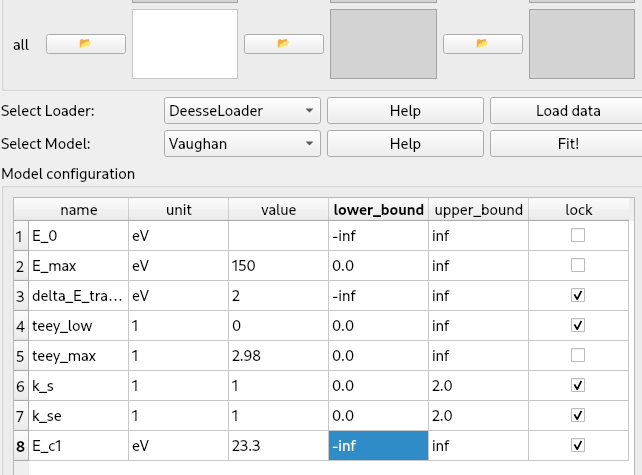
Parameter Vaughan with \(E_{\mathrm{c,\,1}}\) instead of \(E_0\)
When \(E_0\) is unlocked, a fit over this variable is performed to match \(E_{\mathrm{c,\,1}}\).
You must provide either a TEEY file path, either enter the other Vaughan parameters yourself (see image below), and click Fit!.
To-do list
Todo
Unlock \(k_s\), \(k_{se}\) to have better overall fit? In particular: if several incidence angles are provided.
In reality, SPARK3D implementation of Vaughan models EBEEY too!
Threshold energy in CST cannot be negative.