Models
Chung and Everhart
Presentation
This is a model for emission energy distribution of SEs [CE74]. It does not take into account incidence angle of PEs.
Input files
You must provide an emission energy distribution at normal incidence. Currently, the fitting on several emission distribution files at different PE energies is not supported.
Emission Yield |
Emission energy distribution |
Emission angle distribution |
|
|---|---|---|---|
“True” secondaries |
❌ |
❌ |
❌ |
Elastically backscattered |
❌ |
❌ |
❌ |
Inelastically backscattered |
❌ |
❌ |
❌ |
Total |
❌ |
✅ |
❌ |
Definitions
Emission energy distribution is given by:
\(W_f\) is the material work function in \(\mathrm{eV}\). In order to set it’s maximum to unity, we scale it by \(256W_f/27\).
Model parameters
The parameters list is dynamically created here: Chung and Everhart API documentation.
To-do list
Todo
Allow fitting on several distribution files with different PE energy.
Set up tests.
Dionne 3D
Presentation
What the model is for. References. Model.
Input files
Emission Yield |
Emission energy distribution |
Emission angle distribution |
|
|---|---|---|---|
“True” secondaries |
❌ |
❌ |
❌ |
Elastically backscattered |
✅ |
❌ |
❌ |
Inelastically backscattered |
✅ |
❌ |
❌ |
Total |
✅ |
❌ |
❌ |
Output parameters
The list of parameters with associated units.
Sombrin
Presentation
This model was designed to be particularly precise on the first cross-over energy [Som93]. Implementation is taken from [FBHP16, FBHP20]. It gives the TEEY, and does not take the incidence angle of PEs into account.
Input files
You must provide measured TEEY at normal incidence.
Emission Yield |
Emission energy distribution |
Emission angle distribution |
|
|---|---|---|---|
“True” secondaries |
❌ |
❌ |
❌ |
Elastically backscattered |
❌ |
❌ |
❌ |
Inelastically backscattered |
❌ |
❌ |
❌ |
Total |
✅ |
❌ |
❌ |
Definitions
The TEEY is given by:
\(E_\mathrm{param}\) is defined by:
Model parameters
The parameters list is dynamically created here: Sombrin API documentation.
Vaughan
Presentation
This is the most basic Vaughan model, as defined in original Vaughan paper [Vau89, Vau93]. It gives the TEEY, and takes the incidence angle of PEs into account.
Input files
You must provide measured TEEY at normal incidence.
Emission Yield |
Emission energy distribution |
Emission angle distribution |
|
|---|---|---|---|
“True” secondaries |
❌ |
❌ |
❌ |
Elastically backscattered |
❌ |
❌ |
❌ |
Inelastically backscattered |
❌ |
❌ |
❌ |
Total |
✅ |
❌ |
❌ |
Definitions
The TEEY is given by:
\(\xi\) is defined by:
Under the limit \(E_0\) (\(12.5\mathrm{\,eV}\) by default), the TEEY is set to a unique value (\(0.5\) by default).
The \(k_s\) and \(k_{se}\) are both set to unity by default.
The factor \(k\) is given by:
Model parameters
The parameters list is dynamically created here: Vaughan API documentation.
Implementations
Two alternative implementations for Vaughan are implemented: CST and SPARK3D.
Just instantiate your model with:
model = Vaughan(implementation="CST") # or "SPARK3D"
# alternative:
model = Vaughan()
model.preset_implementation("CST")
From the GUI, manually reproduce the steps described in the vaughan.Vaughan.preset_implementation() method.
More specific documentation is also listed in vaughan.Vaughan.preset_implementation().
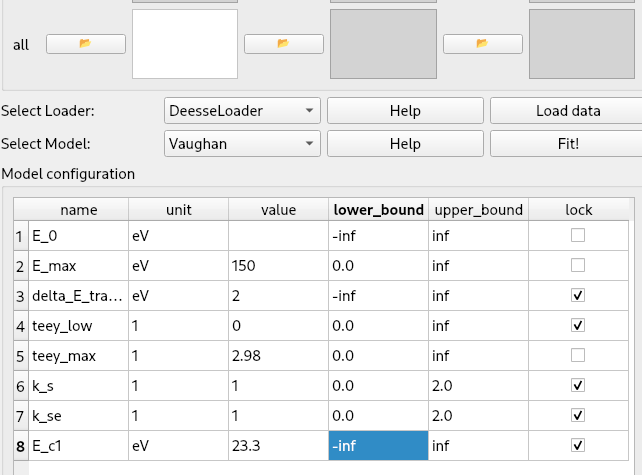
Parameter Vaughan with \(E_{\mathrm{c,\,1}}\) instead of \(E_0\)
When \(E_0\) is unlocked, a fit over this variable is performed to match \(E_{\mathrm{c,\,1}}\).
You must provide either a TEEY file path, either enter the other Vaughan parameters yourself (see image below), and click Fit!.
To-do list
Todo
Unlock \(k_s\), \(k_{se}\) to have better overall fit? In particular: if several incidence angles are provided.
Instructions to match CST Vaughan.
Instructions to match SPARK3D Vaughan.