Notations
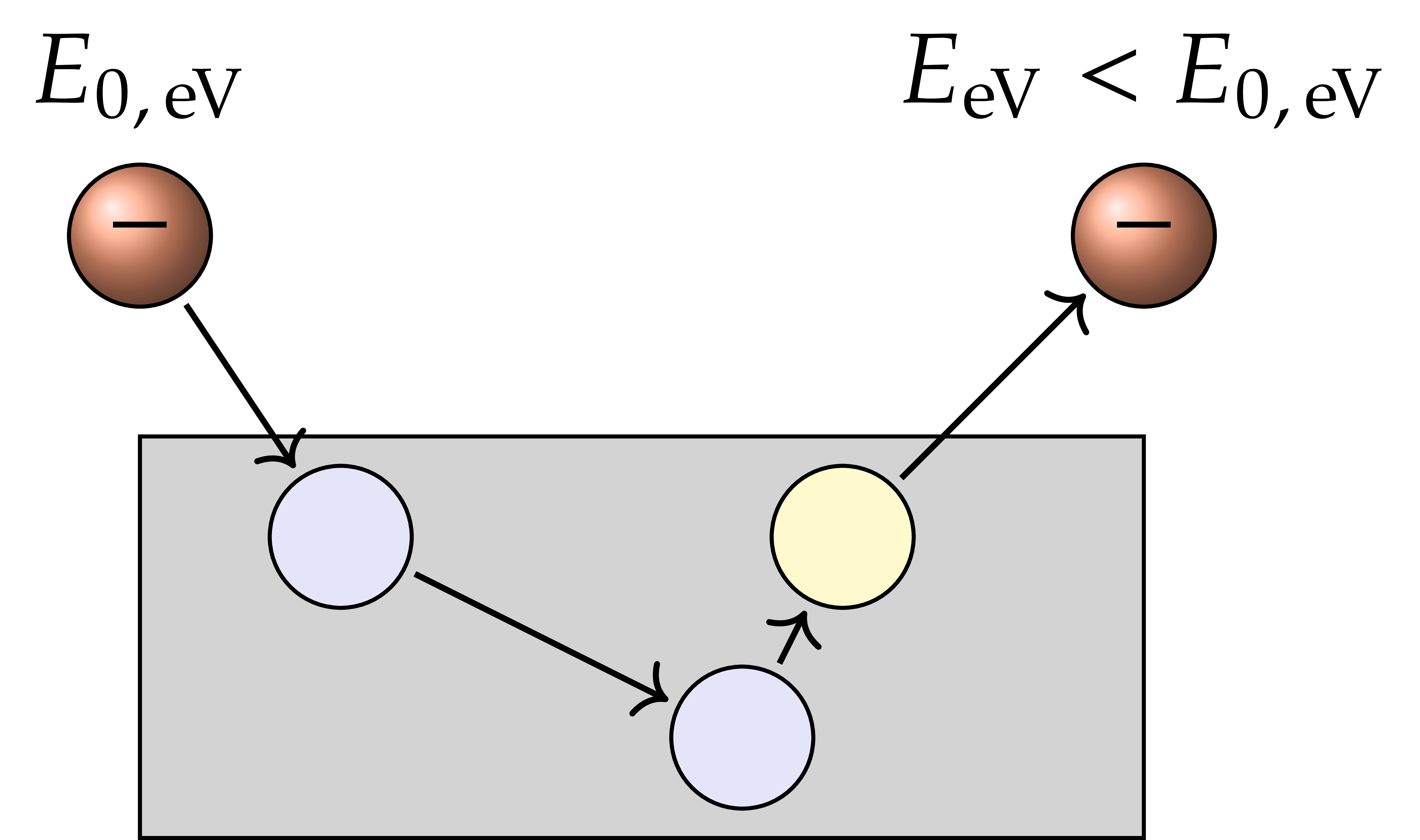
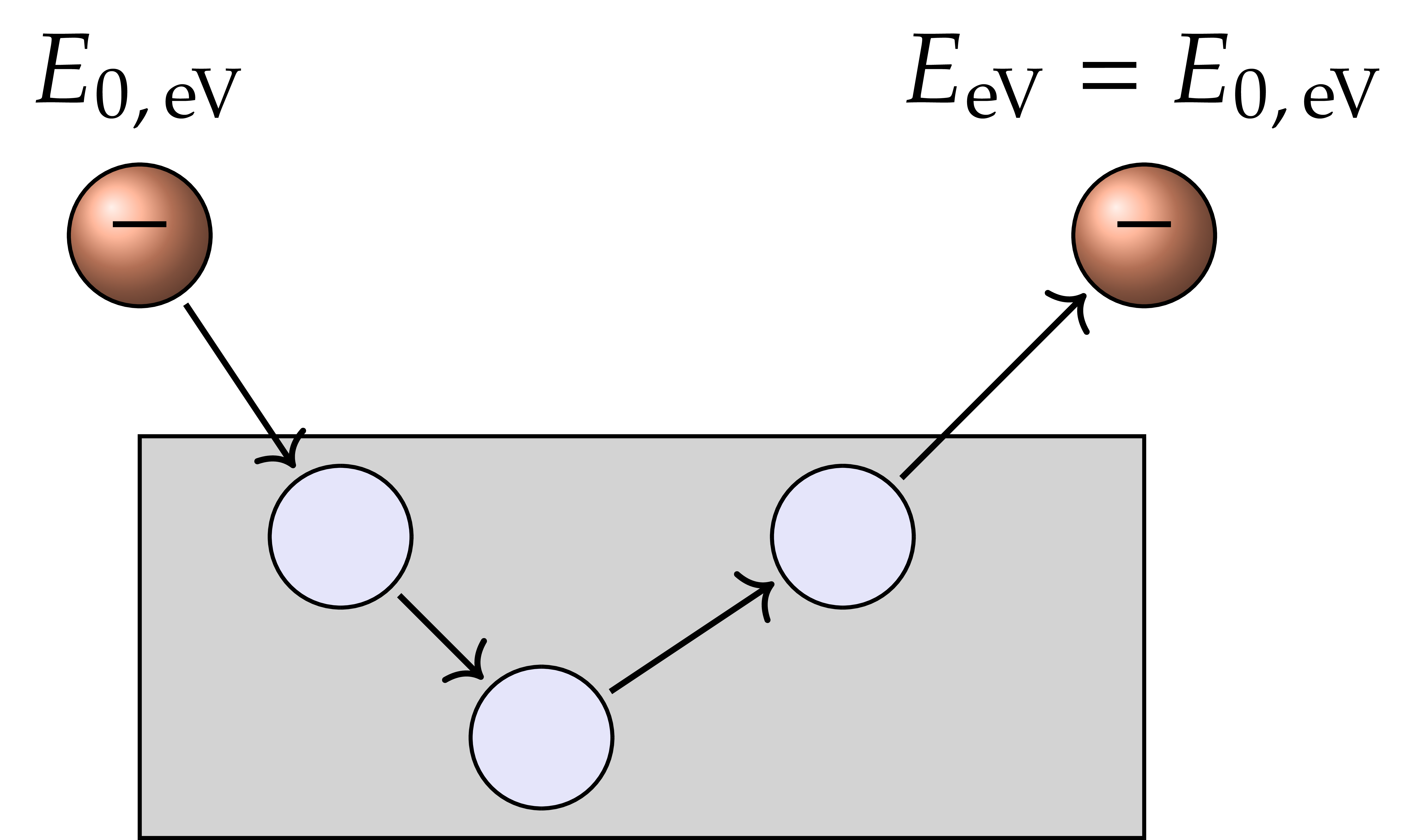
Figures below illustrate a flux of incident electrons, referred to as primary electrons (PEs), striking a sample (shown in gray) with an energy of \(E_{0,\,\mathrm{eV}}\). The sample, in turn, emits electrons (emitted electrons, EEs). The EE flux arises from three distinct physical processes.
Inelastic backscattering
The PE undergoes at least one inelastic interaction and exits the sample having lost part of its energy. Such electrons are called inelastically backscattered electrons (IBEs).
Elastic backscattering
The PE undergoes one or more elastic interactions and is re-emitted without energy loss. These are referred to as elastically backscattered electrons (EBEs).
Secondary emission
The PE ejects one or more electrons from the material which are subsequently emitted. By energy conservation, the sum of the energies of the secondary electrons (SEs) cannot exceed that of the PE [FP02, FP13].
The Total Electron Emission Yield (TEEY) is the sum of the Inelastically Backscattered Electron Emission Yield (IBEEY), the Elastically Backscattered Electron Emission Yield (EBEEY) and the Secondary Electron Emission Yield (SEEY).